Childhood Memories of Little Neston in the 1950s and 60s
THE SALEM HALL – BURTON ROAD
– A place of Worship
Morning and evening services were held there and there was also a Sunday School. The Plymouth Brethren, I believe, may have owned the building which appeared to be built as a place of worship and in any case, they were influential in the worship and services.
The HARE family played a significant role, as did the Pogue family with daughters Sadie and Betty being involved. Tom Hare lived on the Burton Road and had two daughters, Norma and Brenda. He was a carpenter/ and joiner and rode a Velocette motorcycle. He usually led the services and Sunday School. Miss Hare, from Ness, played the organ.
On their way out after Sunday School each child was given what they called a ‘Tex’. This being akin to a cigarette card, dare I say, with text from the Bible quoted underneath a (usually) coloured picture depicting an animal, bird, flower etc. I recall one of a heron at the waterside and I copied it. Over the years I continued to draw herons. Now, many decades later, when doodling, it is a heron, which I could, if I tried, draw with my eyes closed.
At the odd time, there would be an evening ‘film show’ which was open to the public. A missionary recently returned from Africa would show (usually black and white) films of their work, the villages and people. Some were indeed ‘movies’ and what was most fascinating to a small child was that the person or persons in the movies were actually with them in hall in real life!
Once a year there would be an outing (bus/coach), sometimes as far as Prestatyn!
– The School
I remember there were only two classes, split by age, with children from four years of age. The ‘older’ pupils in the ‘back’ room, where they were taught by Miss Bushell. Younger pupils were in the Main Hall with Miss Alderson and Mrs Croft.
The real bonus (at least for the boys) was that at the rear of Salem Hall, there was an embankment, quite high, carrying a railway frequently used by both passenger and freight. The enthralment was incredible at the sight of a huge steam locomotive and train of great trucks (hoppers) marked in big capital letters ‘SUMMERS’. Loaded with iron ore from Sweden (?), they were destined for RICHARD/JOHN SUMMERS STEELWORKS via BIDSTON DOCKS. How fantastic to have the driver, fireman or guard waving, now that was the icing on the cake. At different periods throughout the year, a four-wheel platform carrying railwaymen and tools and equipment would pass by as the line was checked.
After lunch (I had mine at home with my grandmother), folding camp beds were set out in rows. Children then collected their individual blanket from a store by the front door. Blankets were of a fairly course material, grey in colour, each with a motif, thus enabling each child to identify their own. Mine had the outline in red of chicken with yellow beak and legs.
After the nap, children lined up for a teaspoonful of cod liver oil administered by Miss Alderson and a spoonful of thick concentrated orange juice from Mrs Croft. Then followed further activities until home time.
[Editor’s Note: The Salem Hall is now the hall of the Neston Christian Fellowship. It was established in Little Neston by the Open Brethren or Plymouth Brethren. Members from Hope Hall, New Ferry had attempted to establish an assembly in Little Neston in 1821 but in 1826 they acquired the iron building in Park Street which had been occupied by the Labour Party. A leading member of the church was Charles Fallowdown Oulton Lee, a Liverpool solicitor. In the early days following his marriage in 1897 he had lived in Riverslea, Moorside. When he retired he returned to Neston to The Quillets in Lees Lane with his family, including his son Ernest. When larger premises became necessary they considered buying a piece of land in Neston, owned by Kingsley Nicholls who had a dairy in Neston. Eventually, however, they bought a piece of land on Burton Road in Little Neston and building started in 1936. The Hall was designed by Oulton Lee and built, for the most part, by members of the congregation. It was officially commissioned in 1937. Roy Hare, a carpenter/joiner who lived at Eureka on the Burton Road was an Elder and Sunday School Leader for many years until his death. Tom Pogue, originally from Belfast, worked at the shipyards in Birkenhead and cycled to work from Neston every day. He married Rosanna Hare and lived at Mostyn View on the Burton Road. Ernest Lee was an elder of the church until his death at the age of 97, living at the Quillets in Lees Lane.
Sources: Bresnan, Fred, (2002) Assemblies of Christians in the Wirral in Neston Christian Fellowship Newsletter, May – June 2017 [accessed online http://www.nestonchristianfellowship.org.uk/wp-content/uploads/2013/07/May-June-Newsletter-.pdf] and Burton and Neston History Society (1996)Neston 1840-1940, edited by Geoffrey Place]
BUSHELL ROAD SCHOOL
At some stage children were moved to, I think, to the MASONIC HALL in BUSHELL ROAD not far from the railway station. I know not if the SALEM HALL continued to take children or whether ‘BUSHELL ROAD SCHOOL’, as it was called, replaced it. However, it seemed the move was at short notice as the playground at the rear of building was covered entirely in loose cinders! Parents naturally were horrified but I don’t know how the appalling situation was resolved.
In this ‘playground’ was a concrete slab. For whatever reason, it broke into two pieces but remained more or less on top of what later transpired to be a hole. Great interest was aroused, DONALD DOW (from Ness) either put his foot on it or tried to run across it – the slab gave way, Donald falling waist deep in water, his sister Dorothy, hysterical with fear and concern. A teacher was soon on the scene and pulled him out. He was, fortunately, unhurt but shaken. The chamber may have been part of a sewer system.
NESTON COUNTY PRIMARY SCHOOL.
From Bushell Road, children went on to attend the ‘big school’, i.e the Council School, Burton Road.
At one time pupils had to write in their exercise books (red with AVOIRDUPOIS and MULTIPLICATION tables on the back) in the space provided for the school name (which was at that time blank) NESTON COUNTY PRIMARY SCHOOL. This was I assume when education systems, responsibilities and funding changed.
Recycling – nothing new:-
Neston County Primary had, on one or more occasions collected jam jars- hundreds, if not thousands, stockpiled at school awaiting collection. Children carried them to school in their arms, hands, bags and pockets. Each morning they were collected from the classrooms and stacked by the ‘older’ boys (at that time 14/15+). Health and Safety Executive – who?
Remains of school dinners were put in two dustbins and when full, BOBBY ANYON (?), an ‘older’ pupil, took them along Burton Road on a purpose-built trolley to ABELS’. Bill Abel had a market garden/nursery and also kept pigs in Nissen huts. Of course, the pigs would enjoy the ‘swill’. Bobby would take the empty bins back to school for filling.
ROSE GARDENS
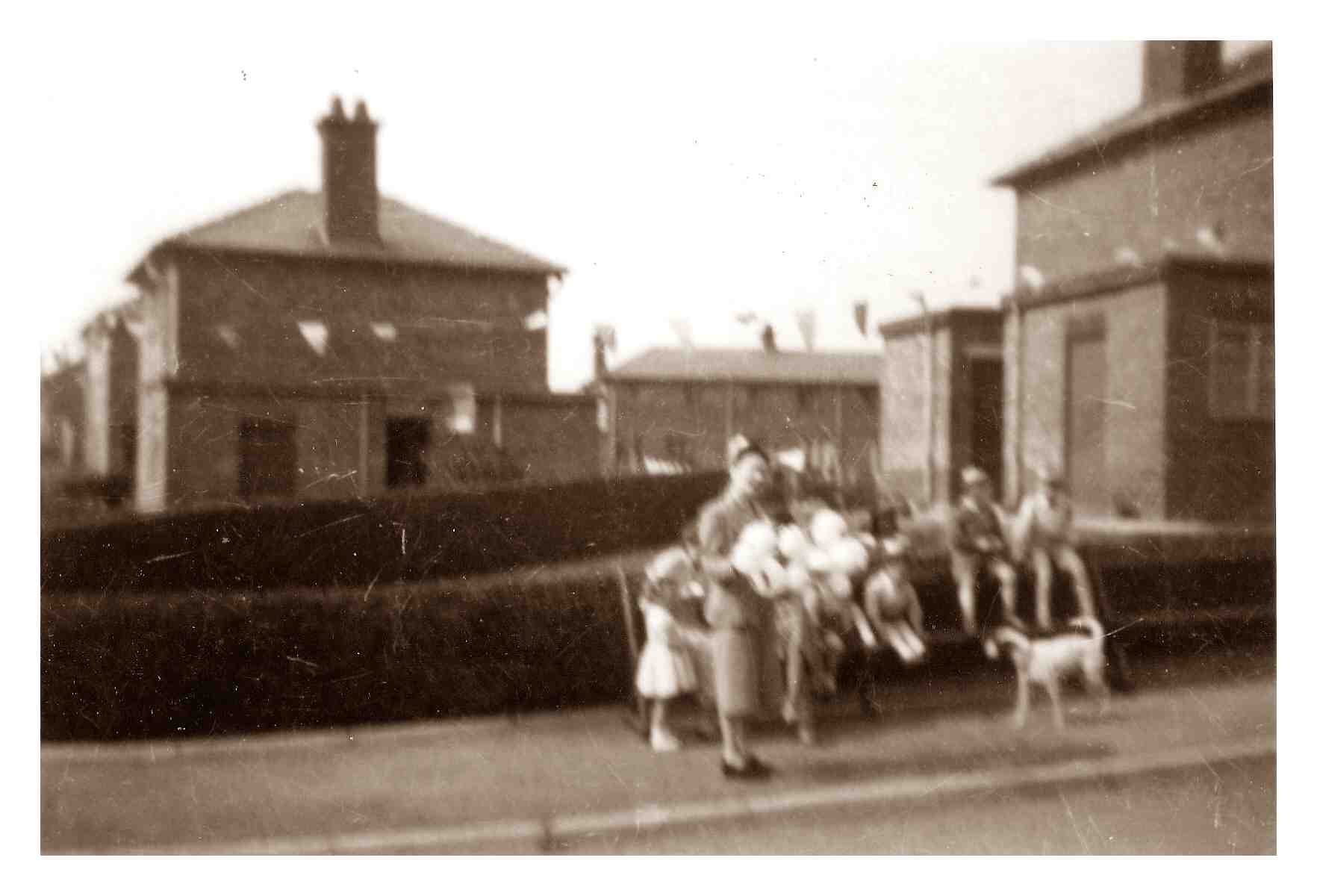
My family was one of the first to move into the new Rose Gardens estate in Little Neston which was built after the Second World War.
The families I remember living at numbers 1 – 7 Rose Gardens on the Burton Road [the houses were re-numbered in 1958] were –
1. Mr Blackbourne who was, I think, an insurance agent and his two children Susan and Christopher.
2. Bill Gabriel who worked at Port Sunlight and had three children, William, Terence and Frances.
3. Mr Croxton, who was a retired farmer, who had a daughter, Dorothy.
At number 4 I remember a few families-
The Bryans with children, Wendy and Peter
Mr Blackwell who worked at Morgan Refractories. The children were Jean and Alan)
The next family were Burke who came from the ‘Colliery’ I think, and it’s possible that the Blackwell family moved down there so there was perhaps a swap
5. Philip Wytcherley who worked at Claude Chrimes Cycles in Chester and his family. The children were Carol and Anne.
6. Stan Jones who worked at Roften in Hooton with daughters Marie, Rosemary Anne ‘Babs’, Nora.
7. Jack Ashbrook who was employed as Clerk of Works for the MoD. He had two sons, Gary and Brian. (He was the nephew of William Ashbrook who had been Clerk of Works on the Rose Gardens project)
On Badger Bait at 8 and 9 Rose Gardens were
Charles Bailey with children John, Betty, Ann and Pamela.
Albert Jones, who was a Crosville bus driver with children Josephine and Kenneth.
Continuing up Badger Bait the families I remember are
The Hares whose daughter was called Alma, the Millingtons with son Stuart and the Griffiths family with children Mary and David.
In the crescent that forms what is, I believe, still called Rose Gardens were-
Albert Mellor who sold shrimps, cockles and flatfish from the Dee marsh as well as other odd jobs. His children were Derek, Jean, Roy, Ruth and Philip.
Mr Lett who was possibly a teacher with children Jeffrey and Raymond.
A family called either Hughes or Cropper with daughters Vivien and Julia.
The Peers with sons Stuart and Malcolm.
The other families I recall less clearly but I believe they were Smith, Jellicoes who had a daughter called Patricia, Young, Donnelly, Hughes with a daughter Glynis and Davies with daughter Joan.